
SEE Grading System 2083: New Letter Grading, GPA, NG & Grade Improvement Rules
Nepal’s Class 10 grading framework follows a 4.0 GPA-based letter grading system. Under the Letter Grading Guideline 2083, students receive grades from A+ to D, while performance below the required threshold is recorded as NG (Not Graded). This guide explains the grading table, GPA, pass requirement, NG, and grade improvement rules in simple language.
SEE Grading System 2083: Quick Overview
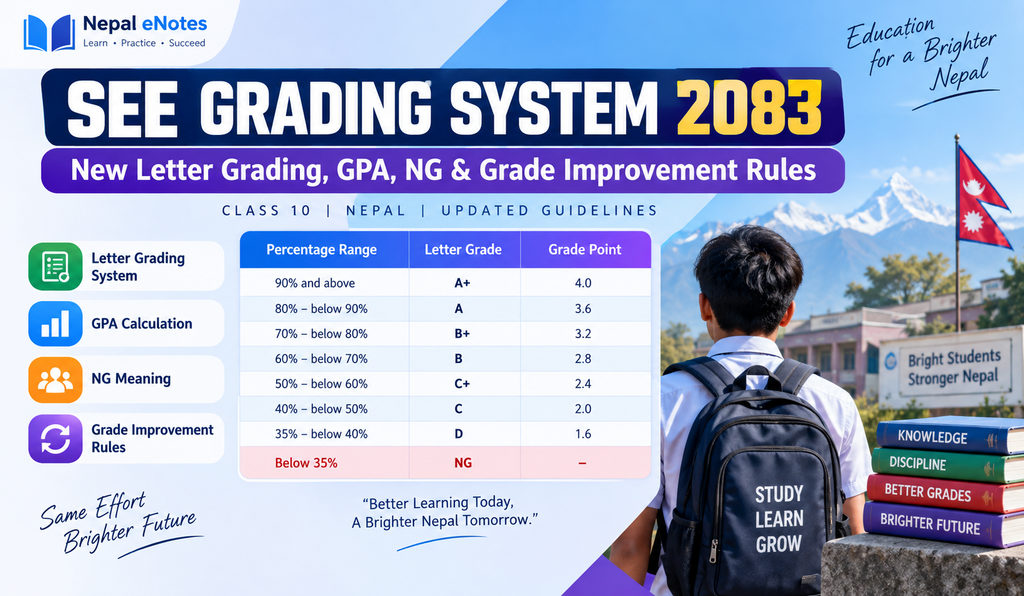
The system uses letter grades with grade points on a 4.0 scale. A+ is the highest grade with a grade point of 4.0. Students generally need at least 35% in a subject to receive a graded result. A score below 35% is recorded as NG — Not Graded.
SEE Grading System 2083: Grade Table
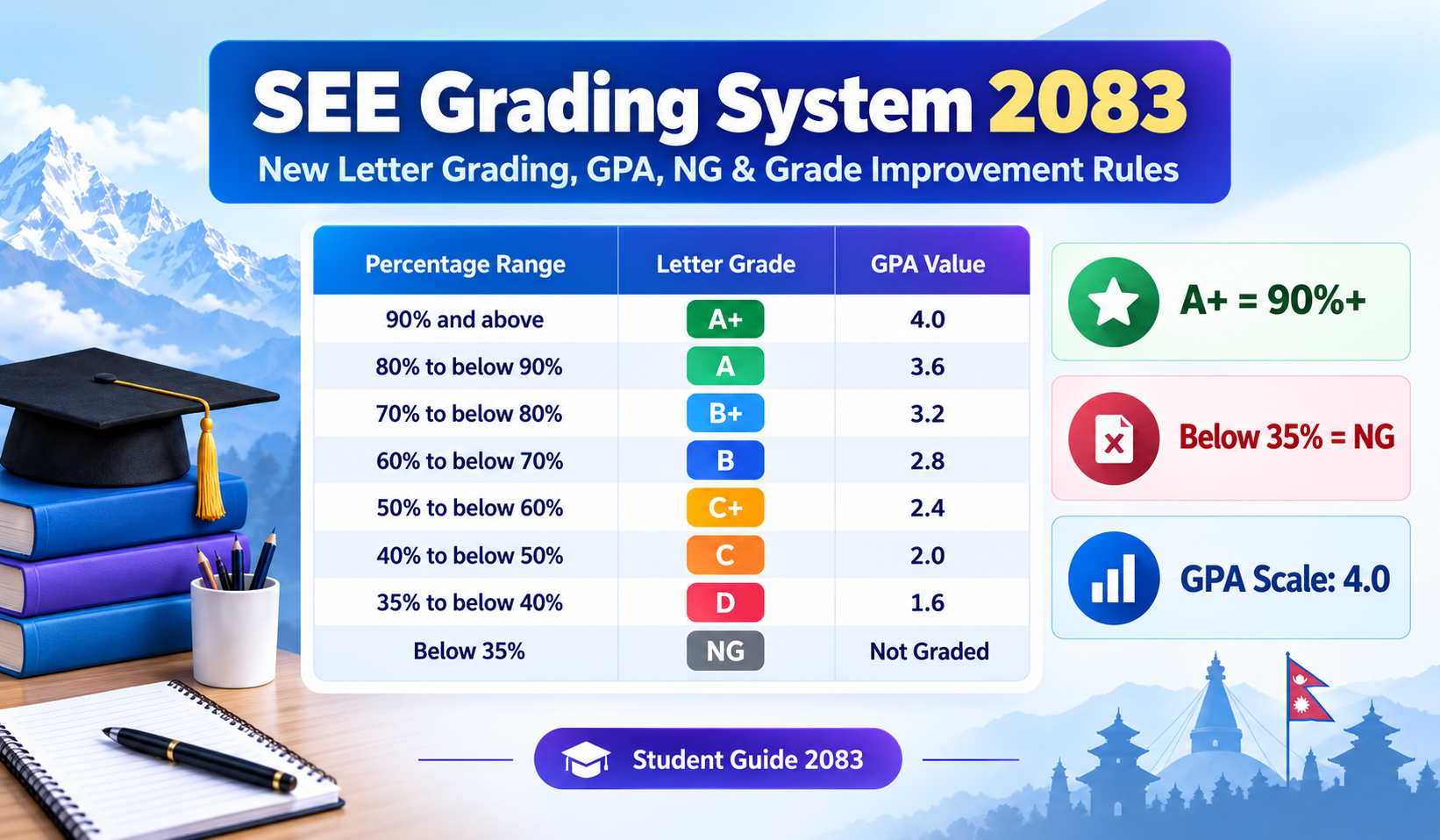
The following table shows the percentage range, letter grade and grade point used under the current Class 10 letter grading structure.
| Percentage | Grade | Grade Point | Performance Level |
|---|---|---|---|
| 90% and above | A+ | 4.0 | Outstanding |
| 80% to below 90% | A | 3.6 | Excellent |
| 70% to below 80% | B+ | 3.2 | Very Good |
| 60% to below 70% | B | 2.8 | Good |
| 50% to below 60% | C+ | 2.4 | Satisfactory |
| 40% to below 50% | C | 2.0 | Acceptable |
| 35% to below 40% | D | 1.6 | Basic |
| Below 35% | NG | — | Not Graded |

What Does Each Grade Mean?
Outstanding
90% or above with a grade point of 4.0.
Excellent
80% to below 90% with a grade point of 3.6.
Very Good
70% to below 80% with a grade point of 3.2.
Good
60% to below 70% with a grade point of 2.8.
Satisfactory
50% to below 60% with a grade point of 2.4.
Acceptable
40% to below 50% with a grade point of 2.0.
Basic
35% to below 40% with a grade point of 1.6.
Not Graded
Below 35%; no regular grade point is awarded for that subject.
What Does NG Mean in Class 10 Results?
NG means “Not Graded.” It is used when a student does not achieve the minimum required performance in a subject. Under the current grading structure, a score below 35% is recorded as NG.
If you receive NG
- The subject is not treated as a normally graded subject.
- No regular grade point is shown for that NG subject.
- You may need to appear in the relevant grade-improvement / supplementary examination.
- Always check the latest NEB/SEE notice for application dates and eligibility.
What should you do?
- Check the official gradesheet carefully.
- Follow the latest SEE grade-improvement notice.
- Prepare the relevant subject again using notes, model questions and past questions.
- Submit the required application through the prescribed process.
How Does GPA Work?
GPA stands for Grade Point Average. Each letter grade has a grade point. For example, A+ corresponds to 4.0, A to 3.6, B+ to 3.2 and so on. A student’s overall GPA is determined from subject grade points under the applicable official calculation method.
Because subject structure and weighting can affect the official calculation, students should use the GPA printed on their official gradesheet as the final result rather than depending only on a simple hand-calculated average.
Grade Improvement Rules 2083
The grade-improvement examination gives eligible Class 10 students an opportunity to improve relevant subjects in which they were absent or received NG. For first-time annual examinees, current guidance allows eligible candidates to appear in the relevant grade-improvement subjects according to the applicable NEB/SEE notice.
Check your gradesheet
Identify subjects in which NG or another eligible status appears.
Check the official notice
NEB / the examination office announces application procedure, fee, deadline and examination schedule.
Apply correctly
Follow the procedure communicated by your school and examination authority.
Prepare the relevant subjects
Use chapter-wise notes, model questions and past questions for focused revision.
Simple Grade Examples
A student scoring 92% falls in the A+ range.
A student scoring 73% falls in the B+ range.
A student scoring 38% receives a D grade.
A score of 32% is below the 35% threshold and is recorded as NG.
Study Class 10 Notes on Nepal eNotes
Explore chapter-wise notes, important questions, model questions and other SEE preparation resources available on Nepal eNotes.
Frequently Asked Questions
What is the minimum percentage for a graded SEE result in 2083?
Under the current grading structure, students need at least 35% in a subject to receive a regular graded result. Below 35% is recorded as NG.
What is NG?
NG means Not Graded. It indicates that the required minimum level was not achieved in that subject.
What GPA is A+?
A+ corresponds to a grade point of 4.0 and applies to scores of 90% and above.
What grade is 35%?
A score from 35% to below 40% falls in the D grade range with a grade point of 1.6.
What happens if I get below 35%?
A score below 35% is recorded as NG. Eligible students should follow the latest SEE grade-improvement / supplementary examination notice.
Can a Class 10 student take a grade-improvement exam?
Eligible students can appear in the grade-improvement examination according to the current grading rules and the specific notice issued by NEB / Office of the Controller of Examinations.
Official Sources & Further Reading
This Nepal eNotes article is a student-friendly explanation based on official education guidance. For the original rules and the latest time-sensitive notices, use these official resources:
- Curriculum Development Centre — Letter Grading Guideline 2083
- Office of the Controller of Examinations — SEE, Grade 10
These are normal outbound links and do not use the nofollow attribute.




Discussion
Share a helpful question, idea, or explanation with other students.