
Last Updated: August 2026 / Shrawan 2083
Artificial Intelligence, virtual reality, augmented reality, 3D environments, intelligent software, and immersive digital experiences are changing the technology industry.
A few years ago, much of this discussion was centered around the metaverse. Today, students should think more broadly. The useful skills behind virtual worlds are also used in AI applications, software development, game development, AR/VR, spatial computing, data science, interactive applications, and other emerging technologies.
For Nepali students completing Class 12, choosing the right bachelor’s course can provide a strong foundation for future technology careers.
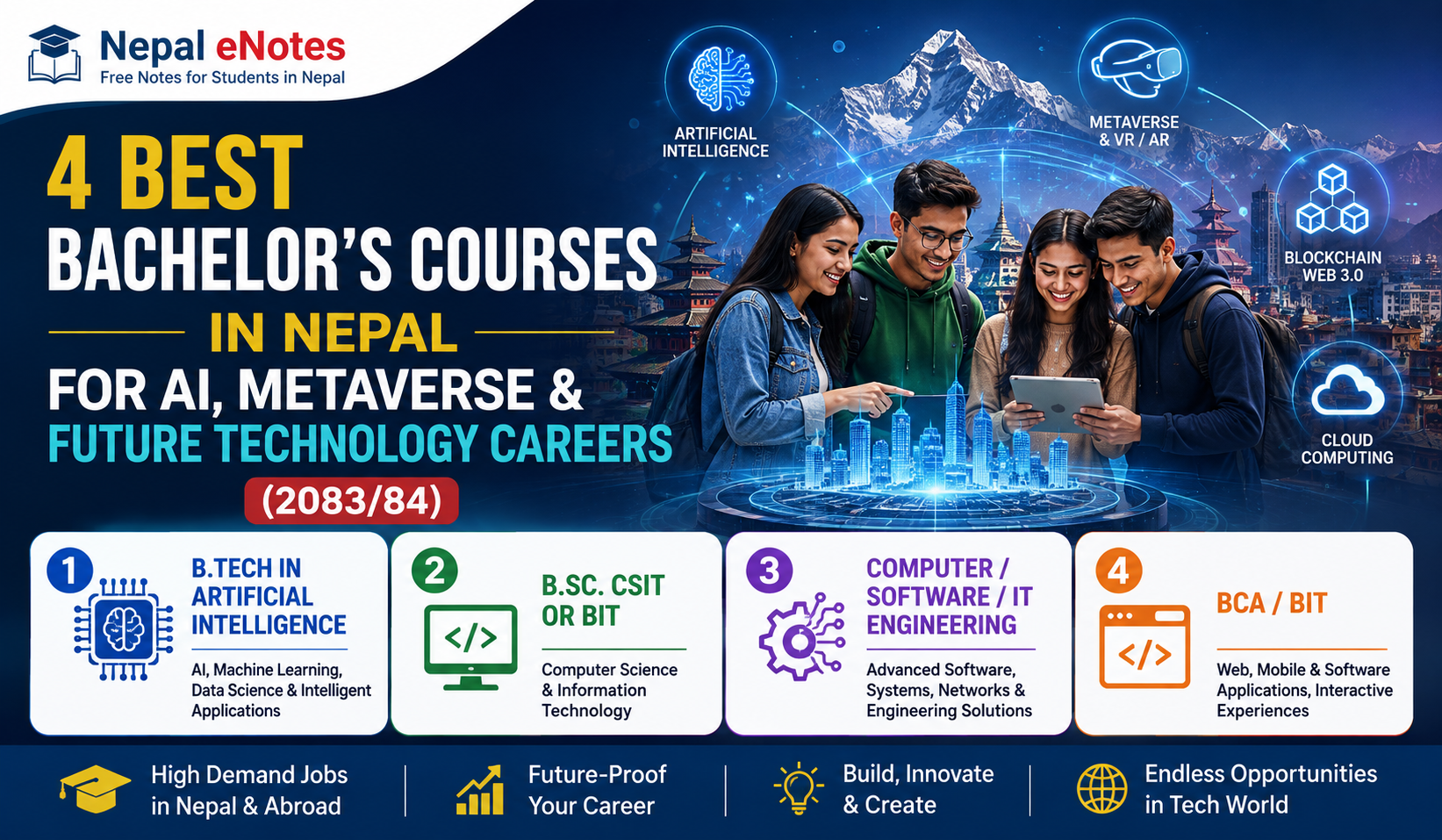
In this Nepal eNotes guide, we look at four of the best types of bachelor’s courses in Nepal for students interested in AI, software, the metaverse, and emerging technology.
Best Courses for AI, Metaverse and Future Technology in Nepal
| Course | Best For | Important Skills |
|---|---|---|
| B.Tech in Artificial Intelligence | AI, Machine Learning and Data | Python, ML, AI, Data Science |
| B.Sc. CSIT / BIT | Computer Science and IT | Programming, Databases, Networks, AI |
| Computer / Software / IT Engineering | Advanced Software Systems | Software, Hardware, Cloud, Networks |
| BCA / BIT | Web, Mobile and Interactive Applications | Programming, Web, Apps, UI/UX |
1. B.Tech in Artificial Intelligence
Best for: AI, Machine Learning, Data Science and Intelligent Applications
Artificial Intelligence is one of the most important emerging areas of technology.
Students interested in creating intelligent applications, recommendation systems, computer vision systems, AI assistants, automation tools, and data-driven software can consider a bachelor’s program focused specifically on Artificial Intelligence.
Kathmandu University currently offers a Bachelor of Technology in Artificial Intelligence (B.Tech in AI) .
What Can You Learn?
- Artificial Intelligence
- Machine Learning
- Programming
- Data Science
- Mathematics for Computing
- Algorithms
- Neural Networks
- Data Analysis
- Intelligent Systems
- Software Development
How Is AI Related to the Metaverse?
Future virtual environments may use AI for:
- Intelligent virtual characters
- AI-powered assistants
- Personalized virtual experiences
- Voice interaction
- Computer vision
- Automatic content generation
- Recommendation systems
- Virtual-world moderation
- Intelligent avatars
The same AI skills are also useful outside virtual environments. This means students choosing AI are not depending on the success of the “metaverse” trend alone.
Who Should Choose B.Tech AI?
This course may suit you if you:
- Enjoy mathematics and programming
- Want to understand how AI systems work
- Are interested in machine learning
- Want to work with data
- Enjoy solving technical problems
- Want to build intelligent applications
Possible Career Areas
- AI Developer
- Machine Learning Engineer
- Data Analyst
- Data Scientist
- AI Application Developer
- Software Developer
- Computer Vision Developer
- AI Research Assistant
2. B.Sc. CSIT or Bachelor in Information Technology (BIT)
Best for: Students wanting a broad computer science and IT foundation
If you are not yet sure whether you want to specialize in AI, software development, cybersecurity, cloud computing, games, or another technology field, Computer Science and Information Technology can provide a flexible foundation.
Tribhuvan University’s Institute of Science and Technology offers undergraduate programs such as B.Sc.CSIT and BIT.
What Can You Learn?
- Programming
- Data Structures
- Algorithms
- Databases
- Computer Networks
- Operating Systems
- Software Engineering
- Web Technologies
- Computer Architecture
- Artificial Intelligence
- Information Systems
Why Is CSIT Useful for Future Technology?
Most emerging technologies still depend on the fundamentals of computer science.
- AI applications require programming and algorithms.
- Virtual worlds require software development.
- Online multiplayer environments require networking.
- Apps and websites require databases.
- Cloud applications require networking and systems knowledge.
- AR/VR applications require programming and computer graphics.
This makes computer science one of the most flexible educational paths for students who want to work in technology.
Who Should Choose B.Sc.CSIT or BIT?
- Students who like computers and technology
- Students who want broad IT knowledge
- Students who enjoy programming
- Students who want several career options
- Students who want to learn software and computer-system fundamentals
Possible Career Areas
- Software Developer
- Web Developer
- Mobile App Developer
- System Administrator
- Network Professional
- Database Developer
- Data Analyst
- AI Developer
- Cloud Engineer
- Cybersecurity Professional
3. Computer Engineering, Software Engineering or Information Technology Engineering
Best for: Students who want deeper engineering and software-development skills
Engineering-focused computer programs can be another excellent path for students interested in future technologies.
Programs available in Nepal may include:
- Bachelor of Computer Engineering
- Bachelor of Software Engineering
- Bachelor of Engineering in Information Technology
What Can You Learn?
- Programming
- Software Engineering
- Computer Hardware
- Electronics
- Computer Networks
- Database Systems
- Operating Systems
- Algorithms
- Web Technologies
- Computer Architecture
- Software Project Management
- System Design
Why Is Engineering Useful for Future Technology?
Creating a complex digital environment involves much more than designing what the user sees.
Engineers may need to build:
- Servers
- Real-time communication systems
- Databases
- Mobile applications
- APIs
- Cloud infrastructure
- Networking systems
- Security systems
- Hardware interfaces
- Software platforms
Who Should Choose This Path?
- Students who enjoy mathematics
- Students who like theoretical and practical technical work
- Students who want to build complex software
- Students interested in computing hardware
- Students who want strong software-development skills
- Students who enjoy engineering problem-solving
Possible Career Areas
- Software Engineer
- Computer Engineer
- Backend Developer
- Full-Stack Developer
- DevOps Engineer
- Cloud Engineer
- Network Engineer
- Mobile Developer
- Systems Engineer
- Game Developer
4. Bachelor of Computer Application (BCA) or BIT
Best for: Web development, mobile apps, software applications and interactive experiences
Students interested primarily in developing applications can consider a Bachelor of Computer Application (BCA) or a Bachelor in Information Technology program.
What Can You Learn?
- Programming
- Web Development
- Database Systems
- Software Development
- Mobile Applications
- Computer Networks
- Information Systems
- User Interface Development
- Software Projects
Why Is BCA Useful for Future Technology?
Users experience technology through applications.
Examples include:
- AI chatbots
- Educational apps
- E-commerce platforms
- Games
- Virtual environments
- AR applications
- Mobile services
Application-development skills therefore remain valuable even as individual technology trends change.
Who Should Consider BCA or BIT?
- Students who enjoy creating applications
- Students who want to learn programming
- Students interested in websites and mobile apps
- Students who want to work in software development
- Students who like building practical projects
- Students who want an IT-oriented career
Possible Career Areas
- Web Developer
- Front-End Developer
- Backend Developer
- Full-Stack Developer
- Mobile App Developer
- Software Developer
- UI Developer
- QA Engineer
- IT Professional
Which Course Is Best for You?
There is no single answer. Your best course depends on what you want to build.
Choose B.Tech in AI if:
You are especially interested in: Artificial Intelligence → Machine Learning → Data → Intelligent Applications
Choose B.Sc.CSIT or BIT if:
You want: Programming → Computer Science → Broad IT Skills → Multiple Career Options
Choose Computer or Software Engineering if:
You are interested in: Engineering → Advanced Software → Computer Systems → Cloud → Hardware + Software
Choose BCA if:
You are most interested in: Websites → Mobile Apps → Software Applications → Interactive User Experiences
Skills You Should Learn Alongside Your Degree
A university degree alone is usually not enough in the technology industry. Students interested in AI, gaming, AR/VR, or future technology should gradually develop practical skills alongside university study.
1. Programming
Start with languages such as:
- Python
- JavaScript
- C
- C++
- Java
You do not need to learn every programming language at once. Choose one language and become comfortable with programming fundamentals first.
2. Artificial Intelligence
Learn the basics of:
- Machine Learning
- Generative AI
- Neural Networks
- Data Analysis
- AI APIs
- Computer Vision
3. Web Development
Learn:
- HTML
- CSS
- JavaScript
- Front-end frameworks
- Backend development
- APIs
- Databases
4. 3D Design
Students interested specifically in games, virtual environments, or AR/VR should consider learning tools such as:
- Blender
- Unity
- Unreal Engine
5. UI and UX Design
Learn basic concepts such as:
- User Interface Design
- User Experience
- Wireframing
- Prototyping
- Accessibility
- Human-Computer Interaction
6. Git and GitHub
Git and GitHub can help students:
- Manage code
- Track changes
- Work with teams
- Store projects
- Build a public portfolio
7. Cloud Computing
As you progress, learn the basic concepts of:
- Cloud servers
- Databases
- Deployment
- APIs
- Containers
- Networking
What About Game Development and VR?
Students specifically interested in metaverse-style environments should pay attention to game development and real-time 3D technologies.
Game engines such as Unity and Unreal Engine can be used to create interactive 3D experiences.
Relevant skills include:
- C# or C++
- 3D Modelling
- Animation
- Game Physics
- Lighting
- User Interaction
- Multiplayer Networking
- AR/VR Development
You do not necessarily need a dedicated “Metaverse Degree.” A strong computer science, software, AI, or IT degree combined with practical 3D development skills can provide a more flexible foundation.
AI vs Metaverse: What Should Students Focus on in 2026?
Students should avoid choosing their entire career around one technology buzzword.
The term metaverse became extremely popular during the early 2020s, but the underlying technologies remain more important than the label.
Instead of learning only “metaverse skills,” focus on transferable abilities:
Programming + AI + Software Engineering + Data + UI/UX + 3D + Cloud + Communication
These skills can be used across:
- Artificial Intelligence
- Software companies
- Games
- FinTech
- EdTech
- E-commerce
- AR/VR
- Robotics
- Cybersecurity
- Cloud services
- Mobile applications
- Virtual environments
Can You Learn AI After Class 12 in Nepal?
Yes. Nepali students can pursue computer-related bachelor’s programs after Class 12, provided they meet the eligibility requirements of the university and chosen program.
Students can consider programs such as B.Tech in Artificial Intelligence, B.Sc.CSIT, BIT, BCA, Computer Engineering, Software Engineering, and other related technology courses.
Eligibility requirements vary significantly between programs. Always check the latest official university admission notice before applying.
Do You Need a Computer Science Degree to Work in AI?
Not necessarily. However, a computer science, AI, software engineering, or related bachelor’s degree can provide structured knowledge in:
- Programming
- Mathematics
- Algorithms
- Data Structures
- Databases
- Computer Systems
- Software Development
Students from other academic backgrounds can also learn AI, but they may need to independently develop these foundations.
Is Metaverse Still a Good Career?
Rather than trying to become only a “metaverse expert,” students should build skills that are useful inside and outside virtual worlds.
- A 3D developer can work in games, architecture, simulation, and VR.
- An AI developer can work across many industries.
- A software engineer can build many types of digital products.
- A UI/UX designer can work on websites, mobile apps, games, and interactive experiences.
Focus on the underlying skill, not only the trend.
Frequently Asked Questions
Which course is best for AI in Nepal?
A specialized Artificial Intelligence program such as B.Tech in AI is one option. Computer Science, CSIT, BIT, Computer Engineering, and Software Engineering can also provide strong foundations for later AI specialization.
Is B.Sc.CSIT good for AI?
Yes. B.Sc.CSIT provides computer science foundations such as programming, algorithms, data structures, and computer systems that can support later study in AI, machine learning, and data science.
Which course is best after Class 12 for software development?
Students can consider B.Sc.CSIT, BIT, BCA, Software Engineering, Computer Engineering, or related computing degrees. The best choice depends on your eligibility and career goals.
Can I become a game developer after B.Sc.CSIT?
Yes. A CSIT degree can provide programming fundamentals, while you can independently learn game-development technologies such as Unity, Unreal Engine, 3D modelling, and game design.
Do I need a metaverse degree?
No. Students interested in virtual environments can build relevant skills through computer science, software engineering, AI, IT, game development, 3D modelling, UI/UX, and AR/VR learning.
Is AI better than the metaverse?
They are not direct alternatives. AI is a broad technology used across many industries, while the metaverse generally describes certain types of immersive virtual experiences. AI can also be used inside virtual environments.
Final Thoughts
Technology changes quickly. A course that is popular today may not be the hottest technology four years from now when you graduate.
That is why students should choose a degree that provides strong fundamentals.
For most future technology careers, a useful foundation includes:
Programming + Problem Solving + Mathematics + Software Development + Data + Communication + Practical Projects
Then specialize according to your interests.
- If you love AI, learn machine learning.
- If you love games, learn Unity or Unreal Engine.
- If you love virtual environments, learn 3D development and AR/VR.
- If you love applications, focus on web and mobile development.
Your bachelor’s degree is the beginning of your learning journey, not the end.
Continue Learning with Nepal eNotes
Students preparing for higher education should first strengthen their Class 11 and Class 12 fundamentals.
- NEB Class 11 Notes
- NEB Class 12 Notes
- 7 Best Public Universities in Nepal After Class 12
- Free Notes for Students in Nepal
Nepal eNotes provides free learning resources to help Nepali students prepare for exams, build strong academic foundations, and make better decisions about their future studies.



Discussion
Share a helpful question, idea, or explanation with other students.