

How to Complete Class 12 Syllabus in 30 Days
A realistic NEB exam preparation roadmap: finish priority chapters, strengthen weak areas, revise actively and practise under examination conditions.
Only a month left before your Class 12 examination? An unfinished syllabus can feel overwhelming, especially when every subject seems equally urgent. The solution is not to read every textbook from beginning to end without a plan. It is to identify what remains, prioritise your learning and measure what you can actually recall and solve.
This guide is suitable for Science, Management, Humanities and Education students. Adapt the schedule to your own registered subjects, official syllabus and examination specification grid. Thirty days can substantially improve preparation, but completing every chapter from zero is not guaranteed.
1. Audit your syllabus before studying
Collect the current syllabus, textbooks, class notes, specification grid and past examination papers. Write down the chapters in each of your actual subjects. Do not assume that every past question will repeat or that old question patterns are unchanged.
Green — Strong
You can explain the concept and answer representative questions independently. Schedule short revision.
Yellow — Partial
You recognise the material but make mistakes or need notes. Allocate practice sessions.
Red — Unfinished
You cannot solve basic questions yet. Prioritise foundational and high-weight material using the current syllabus.
Rank chapters by prerequisite importance, official assessment weight, weakness and the time required. Give difficult foundational topics early sessions rather than postponing them until the final week. Keep a written list of chapters and update it after a closed-book test, not merely after reading.
Study-hours planner
Estimate your available focused study time. Breaks are not included.
Total focused study hoursAverage new-learning time per unitThis average is a planning estimate. Difficult units require more time. Choose a sustainable schedule that protects sleep and school commitments.
2. The complete 30-day study roadmap

Divide your preparation into four stages. These are suggested allocations, not official NEB requirements.
| Days | Focus | Expected outcome |
|---|---|---|
| 1–7 | Audit, foundations and difficult priority chapters | Resolve basic concepts and establish a routine |
| 8–18 | Remaining priority chapters and daily practice | Complete planned first-pass coverage |
| 19–24 | Active revision and previous questions | Improve recall, accuracy and answer structure |
| 25–30 | Timed mocks, error correction and final review | Improve examination readiness |
Days 1–7: Build a strong foundation
Start with a diagnostic test and unfinished chapters that unlock other topics. Study one challenging subject when your concentration is strongest, then alternate with a language or theory subject. At the end of each session, close the book and write a short summary from memory. Reserve the seventh day for a cumulative test and catch-up.
Days 8–18: Finish the planned coverage
Divide remaining units across eleven days, weighting them by difficulty rather than giving every chapter identical time. For each unit, learn the main concepts, attempt a worked example without looking, answer representative questions and record mistakes. If a difficult question stalls progress, mark it and seek help rather than losing an entire session. Use day 18 as a buffer and checkpoint.
Days 19–24: Revise and practise
Switch from reading to retrieving. Write formulas, definitions, diagrams and arguments from memory. Solve questions from current model papers and relevant previous papers. Compare with dependable solutions or teacher feedback and distinguish a conceptual error from a careless mistake.
Days 25–30: Simulate examinations
Attempt timed papers using the actual duration and permitted materials for your subject. Analyse each mock before starting another. Revisit weak topics and repeat missed questions after a delay. On the final day, review concise notes and prepare examination materials rather than beginning an exhausting all-night study session.
3. Daily study timetable
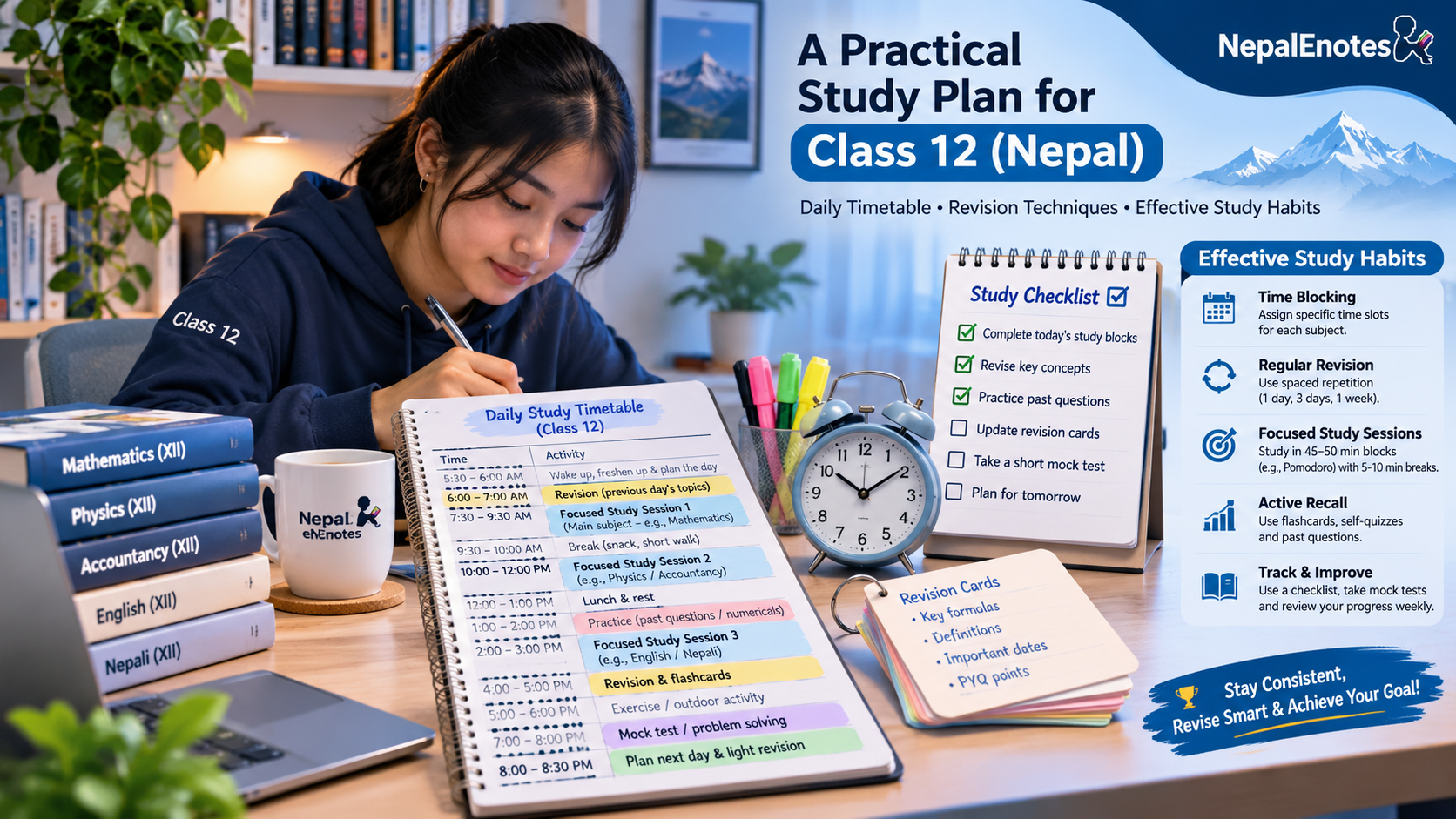
The example below assumes four hours of independent focused study. Adjust start times around school, tuition, meals, travel and household responsibilities.
| Time | Activity |
|---|---|
| 6:00–7:30 AM | Hardest subject: concepts and problems |
| 4:30–5:30 PM | Second subject: unfinished chapter |
| 6:00–7:00 PM | Question practice or writing |
| 8:00–8:30 PM | Closed-book recall and next-day planning |
Take short breaks between focused sessions. If you have only two hours, use 60 minutes for your weakest priority topic, 40 minutes for a second subject and 20 minutes for recall. If you have six hours, add practice and revision blocks instead of extending continuous reading. Protect age-appropriate sleep; most teenagers need 8–10 hours.
4. Subject-wise Class 12 preparation strategy

Use only the subjects in your own curriculum. The following examples describe study methods, not a definitive NEB chapter list.
Physics
Understand principles, practise derivations and solve numericals. Write given values, relevant equations, substitutions, units and final answers. Review graphs and labelled diagrams.
Chemistry
Group reactions by type, practise balanced equations and recall conditions. Solve physical chemistry problems and test yourself on organic conversions.
Biology
Draw diagrams from memory, compare biological processes and practise explaining mechanisms in a logical sequence. Use accurate terminology.
Mathematics
Practise independently rather than watching solutions repeatedly. Record common algebraic and conceptual errors. Repeat representative problems with varied values.
Computer Science
Connect theory to practical examples. Trace algorithms, write short programs where required and practise database, networking and other topics in your syllabus.
Accountancy
Practise full problems using the correct formats. Check totals, adjustments and classifications. Maintain an error log for repeated calculation mistakes.
Economics and Business Studies
Learn definitions, diagrams, assumptions and applications. Practise structured explanations and relevant numerical problems where applicable.
English and Nepali
Practise comprehension, grammar and writing formats. Review prescribed texts and support literary answers with relevant details rather than memorised generic paragraphs.
Social Studies and other theory subjects
Organise concepts into causes, effects, examples and conclusions. Practise concise, evidence-based answers and review prescribed terminology.
5. How to remember more in less time
Active recall
After studying a section, close your notes and answer three questions: What is the main concept? How does it work? Can I apply it? Check your response and correct gaps.
Spaced revision
Revisit material the next day, roughly three days later and again after a week when possible. Adjust intervals according to your recall performance. Do not spend the entire revision session rereading familiar material.
Mixed practice
Once you understand individual methods, mix questions from several topics so you practise choosing the correct method, not merely repeating the previous example.
Maintain an error notebook
For each significant mistake, record the question, your error, the correct reasoning and a date to retry it. Before the examination, review this notebook alongside formulas and concise summaries.
6. Make previous question papers work for you

Start with topic-wise questions during learning. In the revision phase, attempt mixed sections without notes. During the final week, use full timed papers. Check the current specification grid and official syllabus before relying on older papers. Past questions are practice material, not predictions.
After each mock examination
Record marks or teacher feedback, unanswered questions, time lost and the three most important improvements. Schedule a correction session and retry similar questions. A mock is useful only when its results inform your next study session.
7. Your interactive 30-day study tracker
Tick a day only after completing its planned work and a short self-test. Your progress is stored on this browser when local storage is available.
0 of 30 days completed
8. Common mistakes to avoid
- Studying only favourite subjects while ignoring weaker ones.
- Watching lectures without solving questions independently.
- Making beautiful notes instead of testing understanding.
- Changing study resources every day.
- Depending entirely on predicted or repeated questions.
- Attempting mock papers without correcting mistakes.
- Following someone else’s timetable without adapting it.
If you fall behind, revise the plan rather than abandoning it. Protect essential topics, remove optional extra tasks and use buffer sessions. Ask your teacher for help with persistent conceptual gaps.
9. Frequently asked questions
Can I complete the entire Class 12 syllabus in 30 days?
It depends on your starting point, subject load and available time. If you have already attended classes, a focused month may be enough for substantial coverage and revision. Starting every subject from zero may require longer.
How many hours should I study every day?
There is no universal requirement. Choose a sustainable number of focused hours around your existing commitments. Four independent study hours is an example, not a compulsory target.
Can I score a 4.0 GPA by studying for 30 days?
No timetable can guarantee a GPA. Results depend on understanding, assessment performance, internal components where applicable and the official grading system.
Should I study all subjects every day?
Not necessarily. Rotate subjects across the week and use brief recall sessions to maintain continuity. Give weaker subjects additional time.
Should I skip difficult chapters?
Do not automatically skip them. Learn important foundations first, seek help and use the current assessment specification to allocate time. If time is extremely limited, prioritise rather than attempting every detail equally.
Are previous question papers sufficient?
No. Combine them with the current syllabus, textbooks, conceptual learning and model questions. The actual examination may contain unfamiliar questions.
Conclusion: Make the next 30 days count
A successful month is built from consistent daily progress, honest self-assessment and deliberate practice. Begin with your weakest important topic, complete today’s study blocks and review what you learned before planning tomorrow. Focus on what you can control rather than comparing yourself with classmates.
Prepare with Nepal eNotes
Explore Class 12 learning resources, notes and examination preparation materials. Use the resources that match your subjects and current syllabus.
Explore Nepal eNotesThis is an independent study guide, not an official NEB examination schedule or syllabus. Consult your school and the National Examination Board for official information.




Discussion
Share a helpful question, idea, or explanation with other students.